
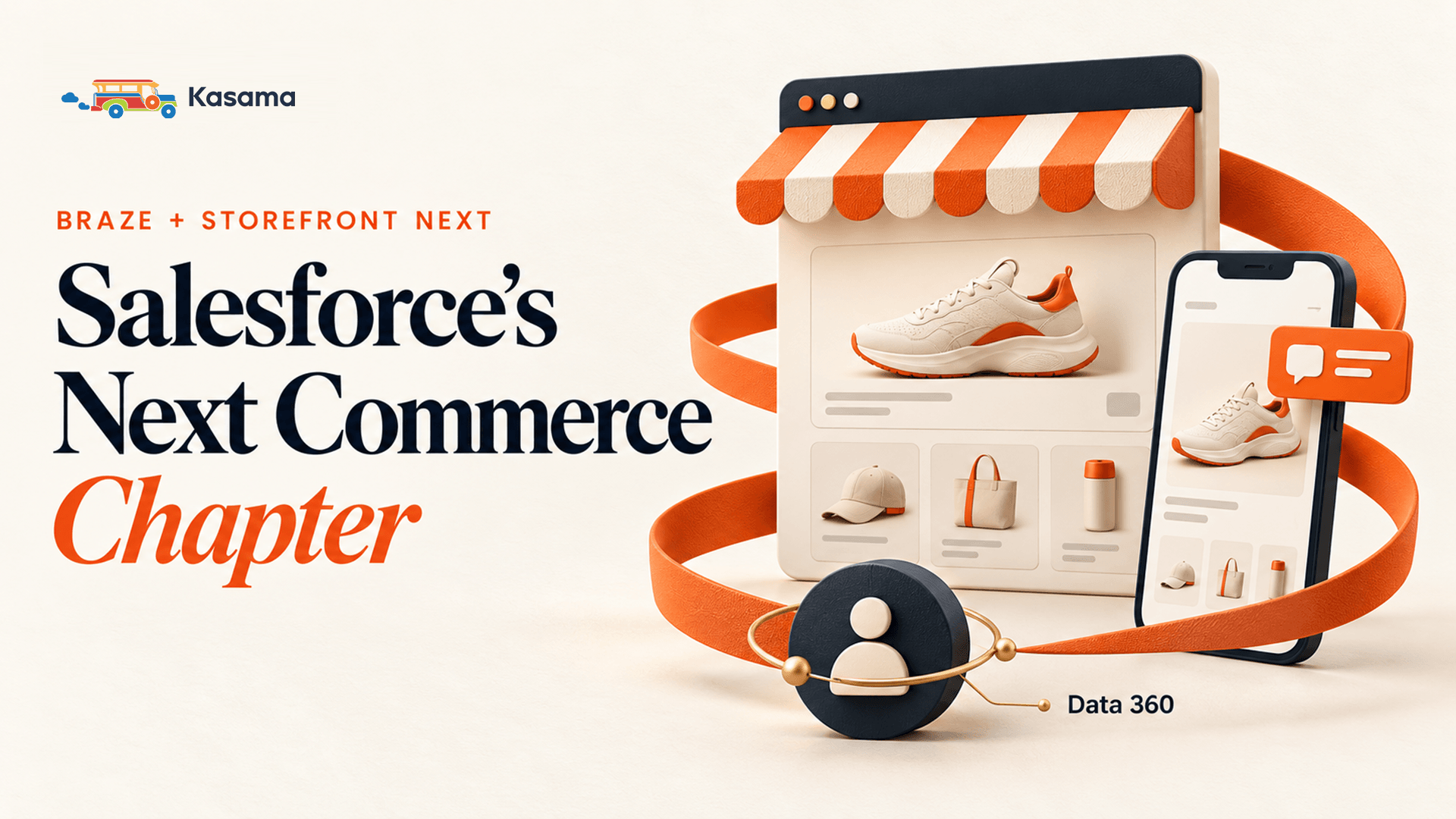
Salesforce announced last week that it has signed a definitive agreement to acquire Braze, the customer engagement platform behind the app and messaging programs of brands like Canva, Instacart, Sephora, FanDuel, and Venmo.
On its own, that is big news for anyone running Salesforce Marketing Cloud. When paired with Storefront Next, which Salesforce made broadly available in June, it also signals to us a clear picture of where Salesforce commerce is heading, and a credible case that momentum is swinging back its way (if you were of the impression that Salesforce had lost commerce steam).
As a Salesforce partner that spends its days inside commerce and marketing builds, we’re optimistic. Here’s why.
What Braze Adds to Marketing Cloud
Braze gives Marketing Cloud the ability to act on what a shopper is doing right now, especially inside a mobile app. That’s a piece customers have been asking for but has been missing from Salesforce’s stack.
Marketing Cloud is excellent at large, well-governed journeys across email and other channels, while Braze was built for the moment-to-moment side of engagement. Its event-streaming architecture updates the customer profile continuously and adjusts journeys in flight, while its in-app messages, content cards, and live updates are among the best in the category.
Salesforce says Braze will strengthen Marketing Cloud's cross-channel personalization and connect with Data 360 and Agentforce. That gives Marketing Cloud a real-time engine, plus a team with more than a decade of mobile and data engineering expertise.
Storefront Next: The Other Half of the Story
Storefront Next is Salesforce's storefront for B2C Commerce, and it has changed the economics of building on the platform. When Salesforce rolled it out, it was part of what Salesforce called its biggest commerce release in five years. Salesforce says a production-ready storefront can be stood up in less than 30 minutes, and Storefront Next is included in every B2C Commerce SKU. In practice, we've seen migrations to Storefront Next from SFRA, Salesforce's previous storefront architecture, done in just a few months.
The details matter for brands and their commerce partners. Storefront Next is a modern React framework that ships with an agentic developer toolkit of more than 40 pre-built skills for the AI coding tools developers already use. Its new Commerce Apps Framework lets teams install partner apps from Business Manager with clicks instead of custom code.
Brands are especially excited about bringing Figma into the agentic development flow, so marketing and design teams can see their vision come to life faster, with fewer handoffs.
The payoff is faster launches, lower build costs, and a storefront designed from the start for personalization and AI.
Where Braze and Storefront Next Meet
Storefront Next modernizes the place customers shop while Braze modernizes how brands talk to customers before, during, and after the visit. When you connect the two through Data 360, the gap between commerce and marketing begins to close.
Here are a few everyday examples of how the customer experience gets easier:
- A shopper browses running shoes on a shoe brand’s Storefront Next site, and then opens the mobile app an hour later. Instead of receiving a generic email the next morning, they see a content card for the exact pair of shoes they were searching for, or nothing at all if they already bought in store.
- A loyalty member is a few points from the next tier. They get a live update on their phone, timed to a visit to the site, which does more than a monthly statement ever will.
- A customer has an open service case about a late order. Because marketing, commerce, and service share one profile, the promotional push scheduled for that afternoon holds until the case is resolved.
Each of these has been possible with enough custom work. What changes now is that Salesforce is assembling the pieces as products, on one data foundation, with AI agents that can act on them.
Why This Could Be Salesforce's Next Growth Story
We’re not trying to say that Salesforce has been failing to this point or is some sort of underdog. It was just mentioned as a Leader in Gartner’s Magic Quadrant for Digital Commerce Platforms and that extended its streak on the list to 11 years. But this has been a hard year for enterprise software sentiment across the board, and Salesforce has taken its share of the skepticism about whether AI agents will help or hurt established platforms. We think Braze and Storefront Next are a strong answer to that question.
Both moves point the same way. Salesforce is investing in the storefront and the message, which are the customer-facing layers where brands win or lose. Salesforce is now pairing these layers with the data and business logic that AI agents need to be useful, such as inventory, pricing, orders, and customer history. Point solutions will find that combination hard to match, and it plays to what Salesforce has always done well. If the integration delivers, commerce and marketing could be where the next chapter of Salesforce momentum starts.
What Brands Should Do Now?
So what does all of these mean tactically for how brands should act next? It depends on what you have and where you are heading into 2027.
- On B2C Commerce: Start planning your path to Storefront Next. The faster build cycle alone justifies the conversation.
- On Marketing Cloud: Keep your roadmap and invest in your Data 360 profile and event data. That work pays off even more with Braze in the picture.
- On Braze: Nothing changes before close. Map where your Braze and Salesforce data overlap so you are ready for tighter integration.
- Evaluating platforms? The Salesforce commerce and engagement story is stronger today than it was at the start of the year. Factor that in.
Where We Come In
We build on Salesforce Commerce Cloud and Marketing Cloud every day, and we are excited about where both are heading. If you want to talk through what Storefront Next and Braze could mean for your brand, from storefront migration to real-time engagement, get in touch with our team.