
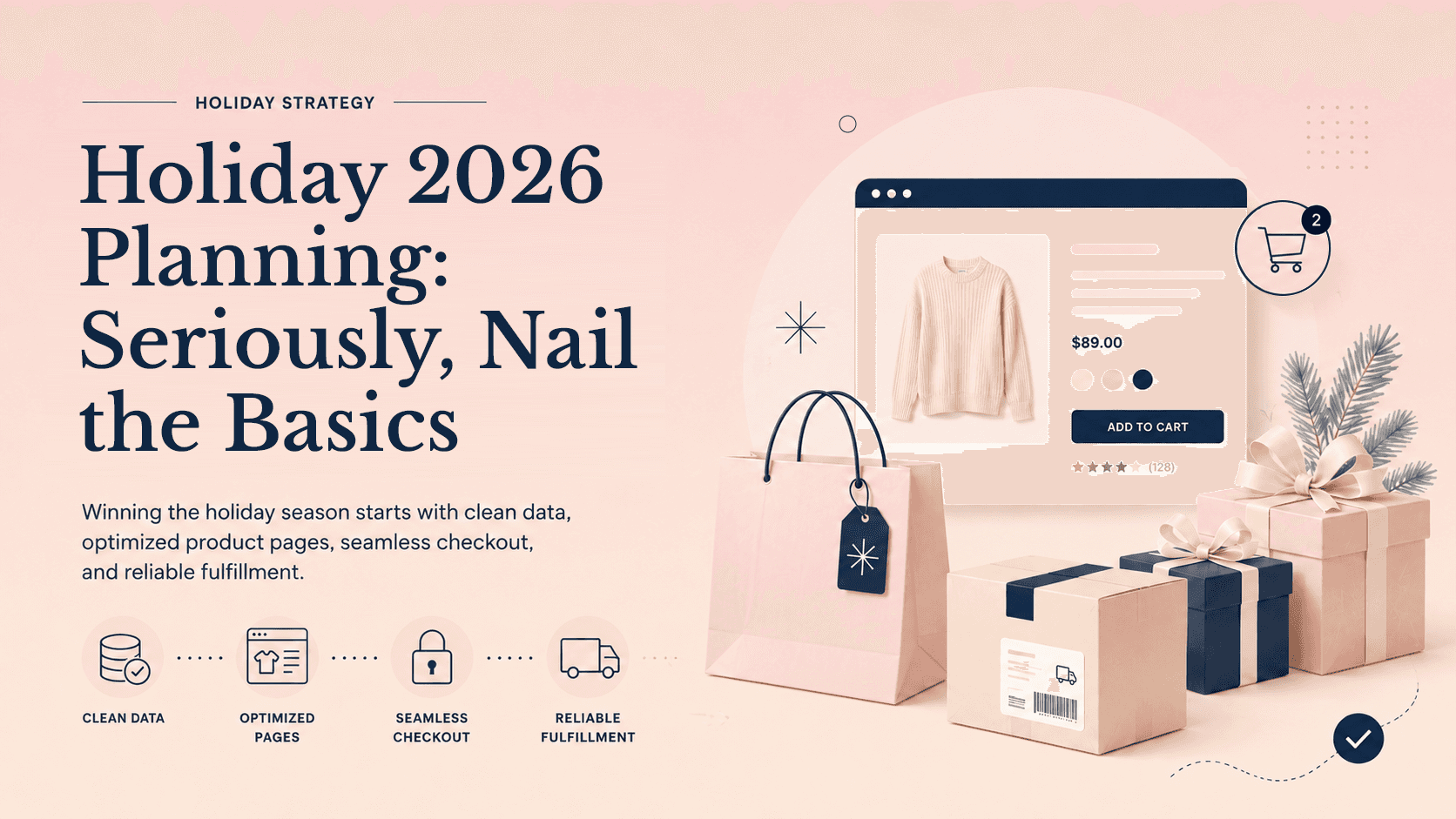
Every year around this time, agencies like us and software providers put out holiday readiness lists that offer what feels like the same advice around executing the fundamentals. The reason is not because we’ve run out of things to say. It’s because that’s the best advice.
Nailing the fundamentals of holiday readiness will move the needle more than any AI-powered personalization widget or chatbot you bolt on in August. You have to make sure your data is centralized and clean. Consumers should be able to find the products they’re looking for and get all the information they need up front. And your OMS and fulfillment processes need to work seamlessly and quickly so that what consumers see on your site or in your store is what’s available and at their door a few days later.
None of this is novel, and that's the point. The basics aren't boring because they're unimportant but instead are repeated because they're the highest-leverage work available, and most teams still don't fully execute on them.
A fancy new tool might earn you a marginal lift in conversion on a good day, but it won’t make up for friction caused by unclear data and product information or slow processes.
Once you get those right (and we can help validate that they are), here are a few other recommendations for a successful holiday season.
Enhance Your PDP Pages
The most important aspects of your ecommerce site during the holidays are your product detail pages. Between search, gift guides, and other promotions, large numbers of consumers are going to bypass your homepage and main nav pages and go straight to your product pages.
Make sure your product images are optimized and that all of the specs, descriptions, and reviews are easy to find. You want consumers to confirm that the product meets their needs quickly and drive a seamless checkout from there.
Turn Off Experimentation
If you're running A/B tests, start winding them down well ahead of the holiday rush. Holiday traffic is not a good time to be splitting visitors across variants. By doing so, you're adding variability to your high-stakes traffic period, increasing the surface area for bugs, and making it harder to trust your conversion data when something looks off on Black Friday morning.
Lock in your winning variants and ship them as the default experience well before launch. Anything still "in progress" by the time Cyber Week hits should be paused. This isn't the season to learn something new about your funnel. Run the version you already know works.
Provide Checkout Options
Consumers want options, especially around fulfillment, during the holidays. As we touch on later, holiday behaviors don’t always mirror the rest of the year. People are buying gifts, needing to have products delivered or picked up from different locations, and paying in different ways.
Some areas in which you should have multiple, streamlined options include checkout methods (delivery, buy-online-pick-up-in-store, etc) and payment methods (credit card, Apple Pay and other digital wallets, and accelerated checkout options). It should be as easy for a consumer to buy a gift for a friend and ship it to the friend’s house as it is for them to buy a product for themself.
Load Test Your Vendors
Most merchants still spend their load-testing energy on the platform itself, and that instinct is outdated. The major platforms have gotten genuinely good at handling holiday-scale traffic. So platform outages during peak season are rare now compared to even a few years ago.
What’s more likely to break are all the other software and tools integrated into the platform. Some to pay attention to include:
- Payment gateways and tax services, which are needed with peak checkout volume.
- Personalization and recommendation engines, which often call out to third-party APIs on every page load.
- Reviews, loyalty, and chat widgets, which can silently degrade page speed without throwing visible errors.
- Email and SMS capture tools, especially around flash sale moments when signups spike.
A single slow or unresponsive third-party script can drag down page load, block checkout, or quietly throw errors that never reach your monitoring dashboard.
Loosen Your Fraud Rules for Gifting
This one trips up more merchants than it should. Standard fraud rules are tuned for typical purchase behavior, and gift buying doesn't look typical. During the holidays, a customer might be buying a higher-than-usual-AOV order, shipping to an address that doesn't match their billing address, requesting rush shipping, or sending multiple orders to multiple addresses.
While it looks suspicious, it’s just that they’re shopping for other people. Their behaviors during the holidays probably won’t match the other nine months of the year.
If your fraud thresholds stay set at their normal-season levels, you'll see a spike in false declines right when revenue matters most. Those declined orders rarely come back. The customer either gets frustrated and abandons, or worse, completes the purchase with a competitor instead.
Work with your payment processor or fraud tool to review and adjust seasonal thresholds now. Look specifically at rules tied to shipping-to-billing mismatches, first-time high-AOV orders, and multi-address orders, since those are the patterns most likely to flag legitimate gift purchases as risky.
Holiday Success Requires a High Floor
Every merchant wants to make a splash during the holidays. The idea of hitting the most critical part of the year out of the park with flash and big plays is an enticing one. But that also comes with big risks.
Sports uses the terms “high ceiling” (who has the greatest potential to reach its peak) and “high floor” (who is most consistently stable and great). It also applies to the holidays. Be a brand with a high floor. That means customers are guaranteed a pleasant and functional experience that meets their needs. It may not be as flashy as a competitor, but it works. That’s where success lives.
And by first doing the basics well, it’s more likely than any more advanced strategies you implement on top are going to work.