A Shopify Implementation for Batesville’s Complex B2B2C Commerce
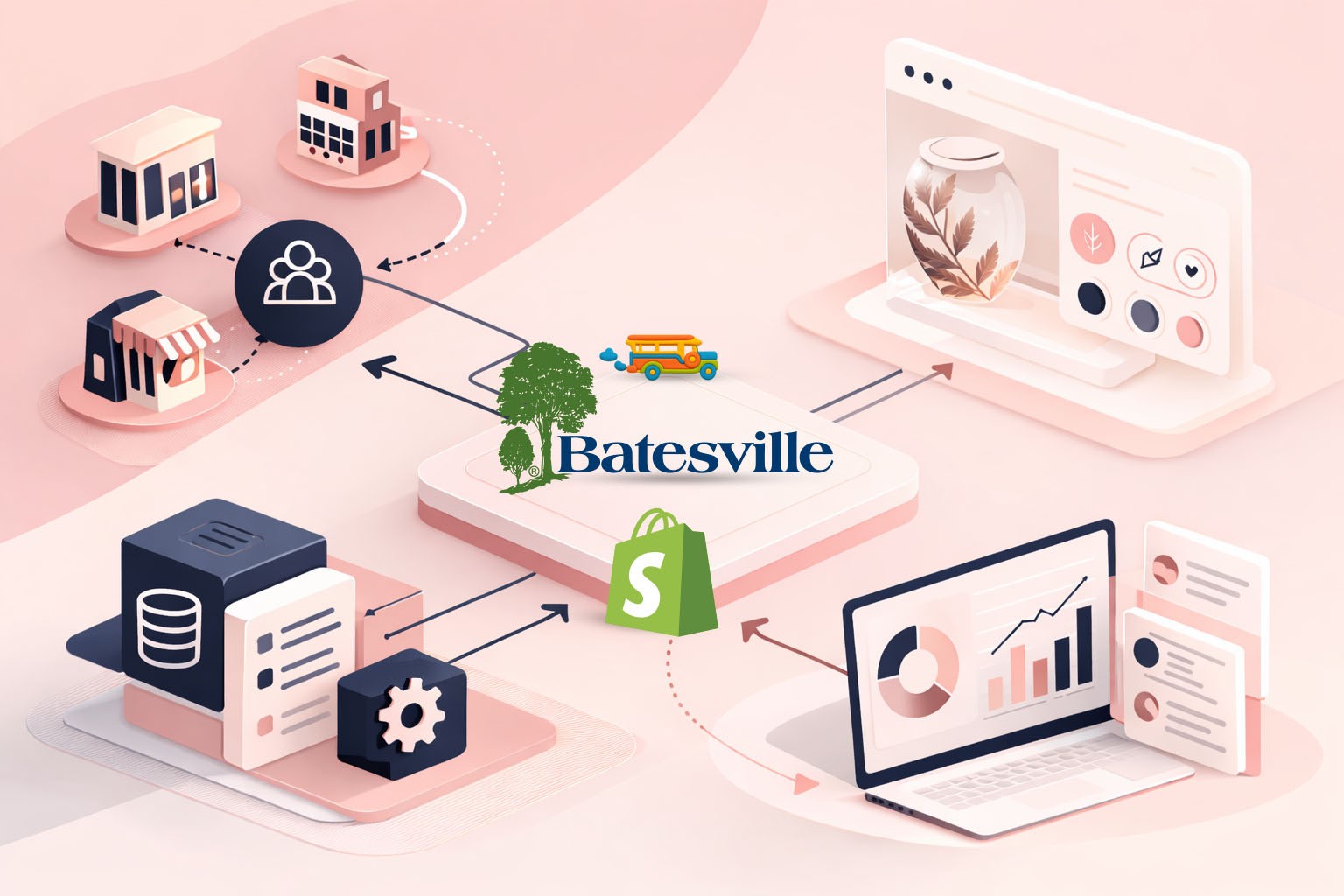
When Shopify Implementation Requires Enterprise Thinking
Many companies choose Shopify because it offers speed, flexibility, and strong out-of-the-box ecommerce capabilities. But for large organizations with complex business models, a successful Shopify implementation requires much more than launching a storefront.
Enterprise companies often need to integrate Shopify with ERP systems, customize the buyer experience, and support multi-party revenue models.
That was the challenge facing Batesville Services LLC, a deathcare industry leader in North America, offering a comprehensive portfolio of burial, cremation, and technology solutions. As part of its digital transformation strategy, Batesville partnered with Kasama, a Shopify Plus partner and ecommerce agency, to launch the Batesville Remembrance Store—a highly customized B2B2C ecommerce experience built on Shopify Plus.
The goal was ambitious: create a seamless online shopping experience for families purchasing memorial keepsake items while ensuring funeral home partners could participate in the revenue generated by each sale.
For organizations considering a Shopify implementation, the project offers several important lessons.
The Business Challenge: Supporting a B2B2C Commerce Model
Batesville needed to solve a complex ecommerce problem.
The Remembrance Store had to support three simultaneous stakeholders:
Families purchasing memorial products
Funeral home partners referring customers and receiving revenue share
Batesville managing fulfillment, pricing, and reporting
To succeed, the platform needed to:
Attribute each order to a specific funeral home partner
Automatically calculate revenue share commissions
Integrate with Batesville’s enterprise ERP
Support advanced product customization with 3D visualization
Scale across hundreds of funeral homes with unique pricing and branding rules
Many ecommerce platforms struggle with these requirements. However, with the right architecture design and a skilled Shopify implementation agency, Shopify can support enterprise-grade ecommerce models.
The Shopify Implementation Approach
Kasama designed a custom B2B2C architecture on Shopify Plus that combined Shopify’s native capabilities with tailored applications and integrations.
Key components of the solution included:
1. Funeral Home–Specific Storefront Experiences
Each funeral home can direct families to the Remembrance Store through a unique URL.
Once the referral is detected, the storefront dynamically adapts.
Funeral home branding is displayed
Product pricing adjusts for the partner
Product availability changes based on partner catalog rules
Orders are automatically attributed to the correct funeral home
This approach allows Shopify to support partner-driven commerce models without requiring separate storefronts.
2. Advanced Product Personalization with 3D Visualization
Memorial products often require customization. To support this, the Shopify implementation integrated Batesville’s 3D product rendering and configuration engine. This enables customers to personalize products in real time.
Customers can:
Add engraving text
Select symbols or medallions
Customize designs before purchasing
See a 3D visualization of the final product
At the time of launch, the Remembrance Store was only the second Shopify store running this commercially available 3D configuration solution.
3. Enterprise ERP and Product Data Integration
Enterprise ecommerce rarely operates in isolation. Kasama integrated Shopify with Batesville’s enterprise systems to ensure accurate data across the business.
The implementation included:
Real-time product, pricing, and variant data from the enterprise product database
Bi-directional integration with the ERP system
Automated order synchronization and reconciliation
Monitoring and retries for failed ERP transactions
This integration ensures operational accuracy while maintaining Shopify’s speed and flexibility.
4. Custom Shopify App for Revenue Sharing
A key requirement of the Remembrance Store was tracking revenue share with funeral homes.
To support this, Kasama built a custom Shopify application that:
Onboards and manages funeral home partners
Tracks referrals and partner attribution
Calculates commissions at the order and line-item level
Adjusts commissions when orders change or are refunded
Generates exportable financial reports
This custom app enables Batesville to manage a complex partner ecosystem from within Shopify.
Benefits of Shopify Plus for Enterprise Ecommerce
The Remembrance Store illustrates why Shopify Plus has become a leading platform for enterprise commerce.
According to Shopify, merchants using Shopify Plus see up to 20% faster site performance compared to legacy ecommerce platforms. Fast, reliable experiences directly impact conversion rates.
For organizations considering a Shopify implementation, key benefits include:
Scalable cloud infrastructure
Rapid development cycles
Strong ecosystem of apps and integrations
Flexible APIs for enterprise architecture
Access to experienced Shopify partners and ecommerce agencies
With the right partner, Shopify can support even highly specialized business models.
Tips for Choosing a Shopify Implementation Partner
Not all Shopify projects are the same. Complex commerce initiatives require experienced teams. When evaluating top Shopify partners or top Shopify implementation agencies, consider the following:
Integration Experience
Ensure the partner has experience connecting Shopify with ERP, PIM, and enterprise systems.Custom Application Development
Complex commerce models often require custom apps.Architecture Expertise
A strong agency will design scalable solutions rather than patchwork integrations.Industry Knowledge
Understanding your business model accelerates implementation.
Choosing the right Shopify ecommerce agency can determine whether your platform becomes a growth engine or a technical bottleneck.
Frequently Asked Questions
What is a Shopify implementation?
A Shopify implementation is the process of designing, building, and launching an ecommerce store using the Shopify platform. This often includes design, integrations, data migration, and custom development.
When should a company use Shopify Plus?
Shopify Plus is best suited for enterprise businesses that need advanced customization, high scalability, and integrations with other enterprise systems.
Can Shopify support complex B2B or B2B2C commerce models?
Yes. With the right architecture and custom applications, Shopify can support partner revenue models, multi-brand storefronts, and complex pricing structures.
What does a Shopify partner do?
A Shopify partner (like Kasama) is a certified agency or developer that helps companies design, implement, and optimize Shopify ecommerce platforms.
How long does a Shopify implementation take?
Implementation timelines vary widely depending on complexity. Enterprise implementations can take several months due to integrations and custom development.
Conclusion: Shopify Implementation at Enterprise Scale
The Batesville Remembrance Store demonstrates how Shopify can power sophisticated commerce experiences when paired with the right architecture and partner expertise.
By combining Shopify Plus with custom applications and enterprise integrations, Kasama helped Batesville launch a scalable B2B2C platform that benefits families, funeral homes, and the company itself.
For organizations exploring a Shopify implementation, the key lesson is clear: Shopify is not just a storefront platform. With the right Shopify partner or ecommerce agency, it can become the foundation for enterprise digital commerce.
Ready to start your Shopify implementation?Learn how Kasama helps companies design, build, and scale ecommerce on Shopify.